
Title got your attention? Good. Picture this and close your eyes. On second thought, read this, then close your eyes and picture it.
A series of adorable cartoon snails. They represent different people/agencies involved in a historic preservation process, so the “government” one has a suit and dark glasses, the “historic property owner” has a house instead of a shell, the one representing “education” has a cap and bandanna like a boy scout, etc. And then there’s one representing Tribal Historic Preservation Offices (THPOs, pronounced “thip-ohs”). It has a teepee instead of a shell, and a headdress and loincloth. OK. Now close your eyes, picture these adorable cartoon snails and decide: is the THPOs one racist?
My students decided that the headdress and loincloth were racist, but in this context – a historic preservation infographic – the teepee was appropriate. This after an extended and raucous conversation, and the admission that no one in the room could really present the view of a Native American. You may well disagree, in which case please explain why and this will inform round 2 of the conversation. Anyway, why do I bring this up?
Lots of people seem to think a liberal arts education and technical skills are at opposite ends of the continuum. I vehemently disagree, in part because of moments like the one described above. This took place in my infographics class, which focuses entirely – at least in theory – on developing technical and design skills. Of course, that’s not how I pictured it at all. I always figured thoughtful conversations would take place in this class, and I’ve been vindicated with only one third of the semester complete.
Working on details shouldn’t mean disconnecting from meaning. A primary benefit of the liberal arts approach is to remember to zoom out and look at the forest, not just the trees.
And now that you’ve been patient, here are the snails in question. Cute, right? And hopefully NOT racist.
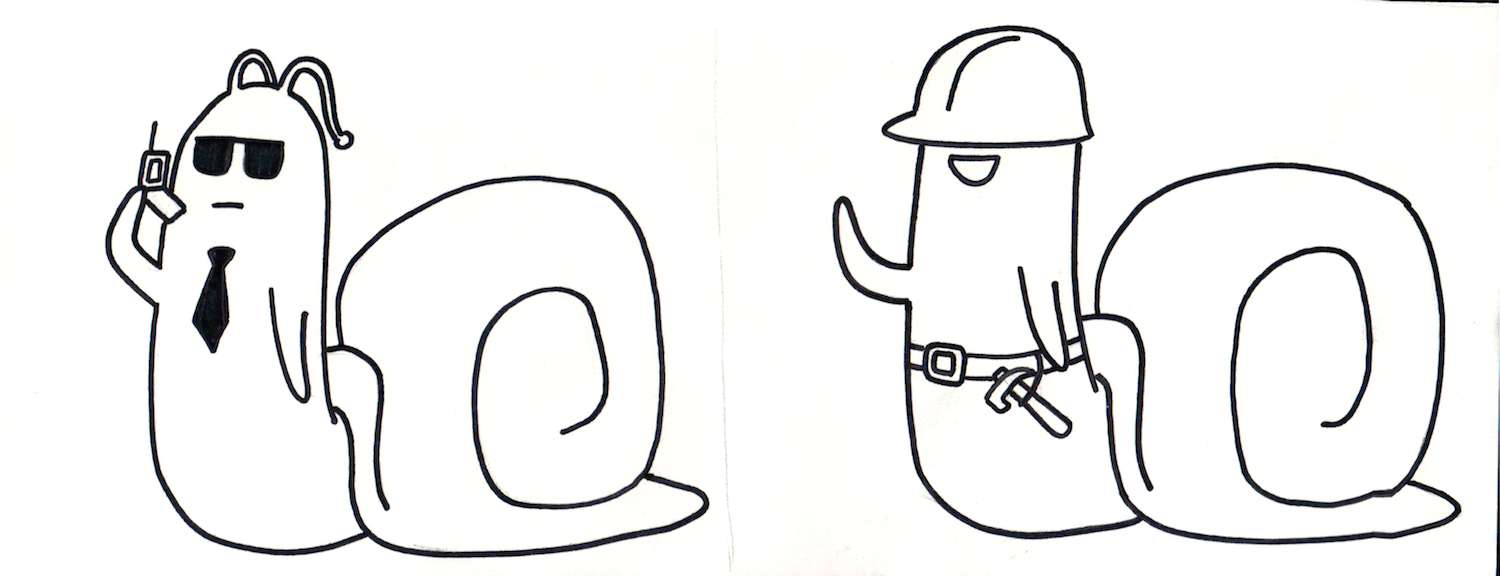

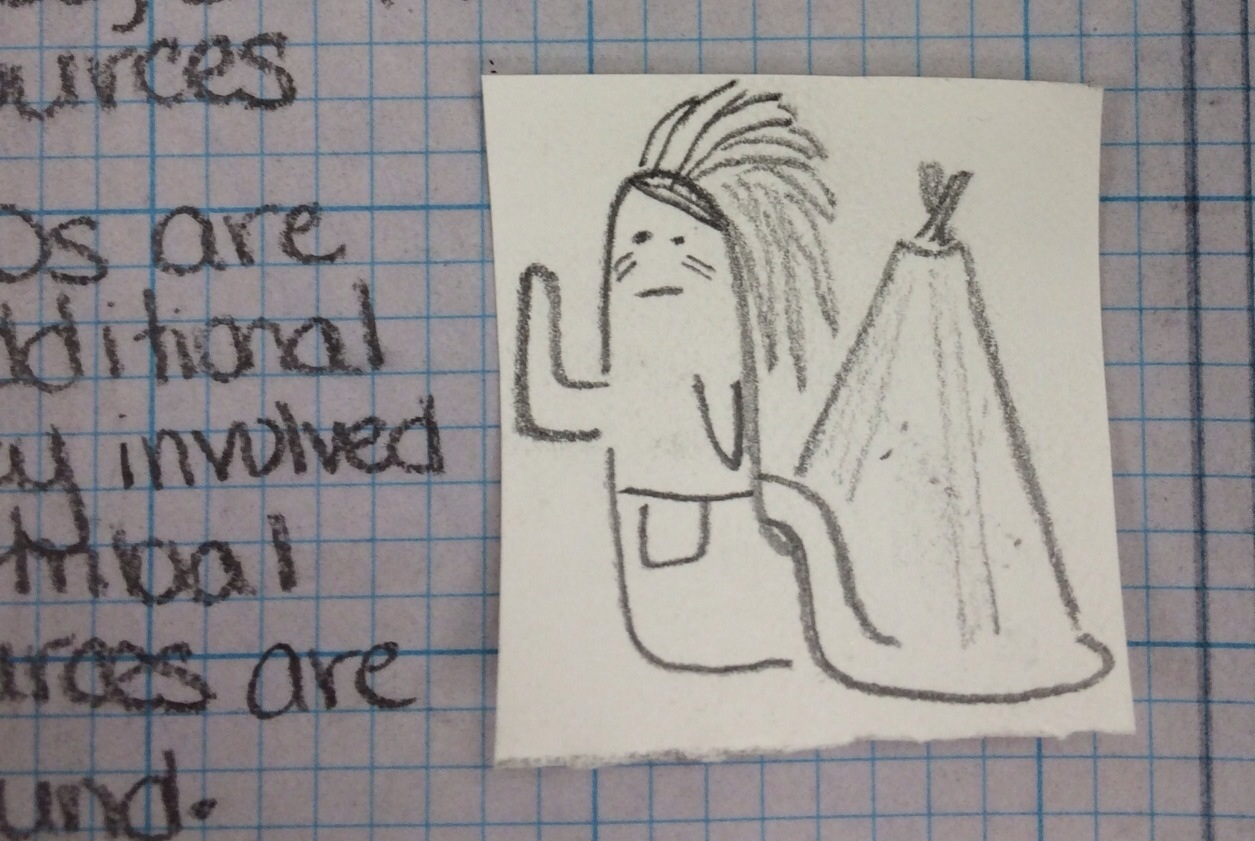
The tepee and Ryan’s comments remind me of growing up in New Mexico and visiting family on the east coast. My cousin’s friends would often ask me questions about the foreign land from whence I came: was I scared of the Indians? did I live in a tepee? did NM have X rated movies? All were measures of civilized v savage and none of them made sense to me. I lived in an adobe house with 18in thick walls, as far from a tepee as I can imagine. The pueblo adjacent to our village was filled with Indians who lived in the same kinds of houses, or trailers, or cinder block houses. The battles were over water and land use. Are there were plenty of X-rated movie houses.
I have never been known to have an opinion on anything (cough) but …
I would disagree that the use of a teepee here is not racist. True, this is a class about historic preservation, and true, the teepee is a traditional dwelling of some of the native peoples of North America. But native peoples used a wide variety of dwellings, depending upon where and how they lived. So why pick the teepee? Along with a headdress, loincloth, tomtoms, and “how” greeting, it’s part of the stereotype we’ve constructed and reinforced for decades. We’ve managed, yet again, to boil down an incredibly complex and diverse set of peoples into a single, uncivilized caricature.
To be clear, not all stereotypes are racist. When stereotypes are used, along with a structural power imbalance, to dehumanize or otherwise inflict harm based on one’s (real or perceived) ethnic or racial background? It’s racist. Even if that’s not the conscious intent of the illustration here, and I don’t believe it is … “i didn’t mean to” doesn’t and can’t remove the teepee from the larger historical and cultural landscape of cultural appropriation, racism, and genocide inflicted upon the native peoples of North America.
tl;dr The teepee is racist, racism doesn’t require intention, and I’m really glad you’re having these conversations in your class. (Seriously — that’s no snark.)
Thanks for the feedback, Ryan & Melina! We had a second round of conversation in class and ultimately chose to keep the teepee. Here’s why:
These kinds of situations are tough, because whatever you do you may well offend. There’s no way to make 100% sure not to be racist. The options as we saw them were as follows.
– use a longhouse, which is typical of tribes in the east coast. Problem: no one in the general public would have any idea what it is.
– use a wigwam, also used in this area. Problem: it was a very primitive shelter, which has bad connotations.
– use an adobe pueblo. Problem: it isn’t well understood by people outside the southwest. Many would mistakenly think of Hispanic culture instead of Native American culture.
– use a totem pole. Problem: they’re not housing and they are generally negative in the first place.
– use a plank house. Problem: those only exist in the northwest and look like regular wood houses to an undiscerning eye.
This leaves us with two options: either keep the teepee or not use a cartoon at all and just have a THPO sign. I think the second option would be capitulation. It would also send the message that THPOs are to be treated differently, that they aren’t worthy of humor or that the designers were scared.
So in the end, the teepee remains. I think it works in this context. Going through section 106 with a THPO may well involve remnants of teepee sites. Furthermore, teepees are incredible feats of architectural design. There is a reason they were – and sometimes still are – used so commonly. Anyway, I’d love more responses about this. Time spent discussing these issues is well spent, as far as I’m concerned.
It’s clear that you and your students have put a great deal of thought into this, which is great. Have you considered finding a way to signal that on the infographic itself? For example, perhaps you could use a footnote to acknowledge the intentionality of the decision and briefly summarize the reasoning. Just another way to provide more info in your infographic 🙂